.svg)

Part 2: Agentic OMS - what it is, what it isn't, and why the difference matters

Key Takeaways
- "Agentic" is not a synonym for AI-enabled or AI-driven. It represents a different layer of operational intelligence.
- An Agentic OMS monitors and adapts continuously. A rules-based OMS makes one decision per order and moves on.
- AI-enabled, AI-driven, and Agentic can coexist. The question is whether your architecture supports all three.
This is the second article in fulfillmenttools' ongoing series on Agentic Order Management. If you missed the first, start here: "The age of the Agentic OMS has begun."
Introduction
New categories attract loose language. When a concept gains momentum, the terminology around it tends to expand faster than its meaning. "AI-powered", "intelligent", "agentic" — these words are appearing on an increasing number of product pages, often describing very different things.
That's a problem when you're making infrastructure decisions that will shape your fulfillment operations for years.
This article is an attempt at precision. We'll define what an Agentic OMS actually is, what it isn't, and why the distinction matters for enterprise retailers who are serious about building on the right foundation.
A brief note on the AI stack
Before we define Agentic OMS, it helps to understand where it sits in the broader AI landscape.
Most people are familiar with LLMs like GPT: models that generate text based on patterns in data. AI Agents go a step further. They use LLMs as a reasoning engine, but combine them with the ability to take actions, access tools, and pursue goals across multiple steps. Agentic Systems are networks of such agents working together. And Agentic Infrastructure is the operational layer those agents depend on to act in the real world: real-time data, reliable decisions, and live system connectivity.
That last layer is where the OMS sits. And it's why the architecture of your OMS matters more than it ever has before. We'll go deeper on this stack in a dedicated article later in the series.
What an Agentic OMS is
An Agentic OMS is an order management system designed from the ground up to support autonomous, goal-driven decision-making across the fulfillment lifecycle.
Three things distinguish it from what came before.
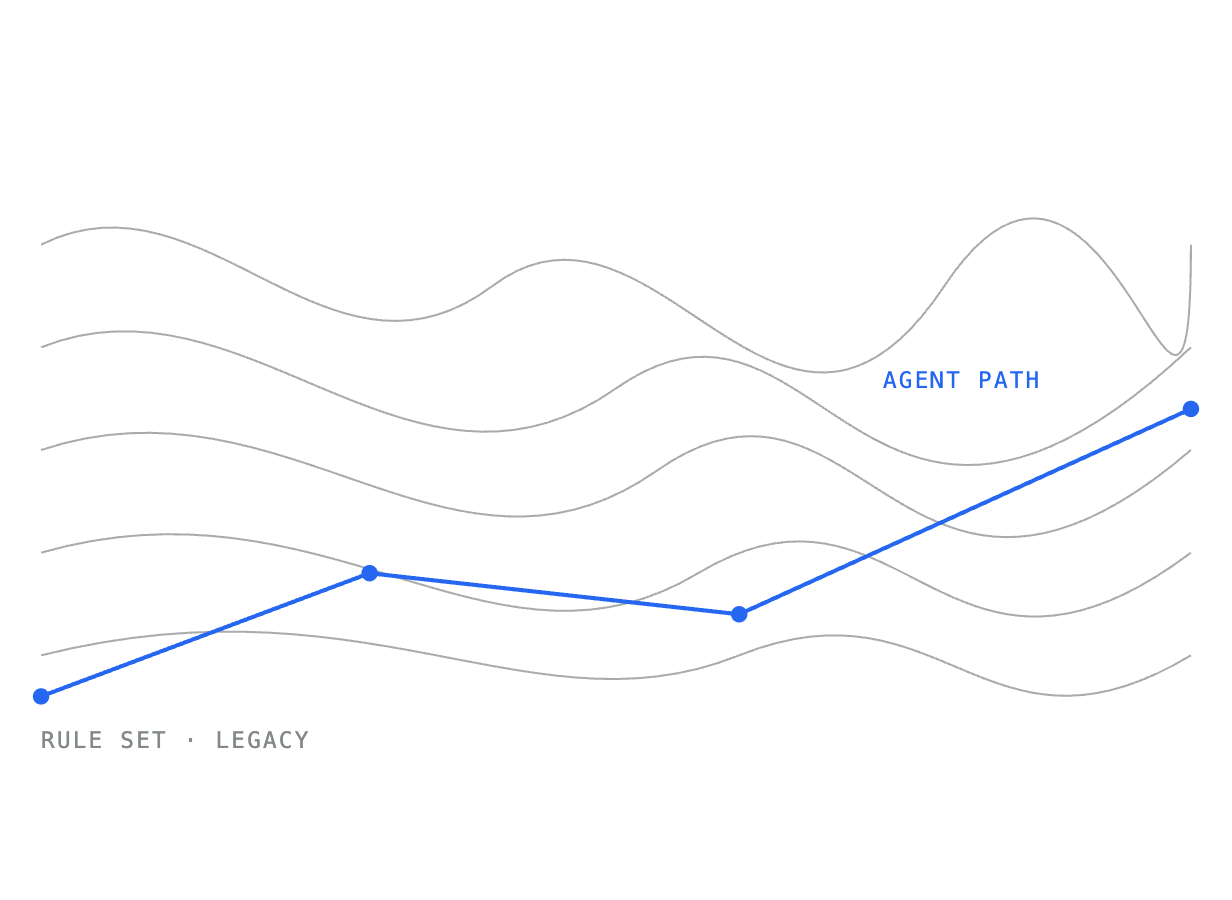
It monitors and adapts continuously, not once per order. Traditional systems make one routing decision when the order enters the system, then move on. An Agentic OMS evaluates conditions continuously. If something changes in the network — a warehouse becomes unavailable, carrier performance degrades, inventory shifts — the system reassesses and adjusts, even for orders already in flight.
It optimizes toward goals, not fixed rules. Rules are brittle. They encode assumptions that were true when they were written and break when conditions change. An Agentic OMS operates toward defined business objectives, learning from the network and refining its approach based on real outcomes, not static rule sets.
It connects to the broader agent ecosystem. As AI agents become part of commerce operations, from customer service to demand forecasting, they need a reliable operational layer to act on. An Agentic OMS provides that layer: real-time inventory, live delivery promises, and fulfillment decisions that external agents can trust and build on:
- An Agentic OMS reevaluates decisions continuously as network conditions change.
- It learns from outcomes and adapts its approach, rather than following fixed rules.
- It serves as the operational foundation for the broader agent ecosystem in commerce.
The evolution: from classical OMS to Agentic OMS
To understand what makes an Agentic OMS different, it helps to trace the evolution.
Classical OMS: Order status and processing
A classical OMS was built around order status management. It tracked where an order was in its lifecycle, managed modifications, handled payment processing, invoicing, and after-sales. The model was simple: one e-commerce system, one fulfillment location. Availability checks and routing weren't central concerns because there was only one place the order could go.
Distributed OMS: Orchestration across multiple nodes
The DOMS emerged when retailers began operating multiple fulfillment locations. The architecture shifted from a 1:1 relationship to 1:n, and eventually to n:n — many sales channels interacting with many fulfillment nodes, even reaching into the supply chain.
The strength of a DOMS is orchestration. It knows multiple locations, availability across the network, carrier options, and attempts to route optimally based on that information. But the routing logic is predefined through fixed rule sets. Rules are evaluated sequentially, like steps on a staircase: if condition A is met, route here; if not, check condition B, and so on.
In the shift to composable commerce, many DOMS platforms also offloaded capabilities like payment, invoicing, and after-sales to third-party systems — ERPs, CRMs, shop systems. Whether that trade-off was right is debatable. Many enterprise retailers still want the comprehensive order processing of a classical OMS combined with the distributed capabilities of a DOMS.
Where fulfillmenttools differs from classical DOMS
Classical DOMS platforms route based on fixed, sequential rule sets. fulfillmenttools takes a fundamentally different approach: scoring-based routing. Instead of evaluating rules in a rigid sequence, the system scores every fulfillment option across multiple dimensions — proximity, cost, delivery speed, inventory confidence — and selects dynamically based on those scores. This allows for far more flexible and context-sensitive routing decisions than traditional rule hierarchies permit.
But that's still not agentic. It's a more advanced form of DOMS. The step to Agentic happens when the system begins to reevaluate and adapt continuously.

What an Agentic OMS isn't
This is where precision matters most.
An AI-enabled OMS adds AI features to an existing OMS architecture
This might mean AI-powered demand forecasting, anomaly detection, or intelligent reporting. These are valuable additions. But layering AI features onto a rules-based foundation doesn't change the underlying architecture. The system is still fundamentally reactive. The AI is a feature, not the operating principle.
An AI-driven OMS uses machine learning to optimize core processes
This is a meaningful step forward. Instead of static rules, the system uses algorithms to optimize routing, inventory allocation, or carrier selection based on historical data and patterns. fulfillmenttools' Advanced Order Routing is an example of this: it uses intelligent algorithms to score and evaluate fulfillment options dynamically.
But AI-driven is still not agentic. AI-driven systems optimize within defined parameters. They make better decisions based on data. But they don't autonomously monitor the entire network, reassess decisions in real time, or proactively identify and mitigate risks before they materialize.
Agentic adds autonomous oversight and continuous adaptation
An Agentic OMS goes further. It acts as an autonomous controller that continuously monitors, analyzes, questions, and refines. It watches the network in real time, detects risks as they emerge — or even before they emerge — and adjusts accordingly.
Take the example of carrier performance. A static system assumes DHL takes three days for delivery, period. An AI-driven system might use historical data to refine that estimate to 2.8 days on average. An Agentic system connects to a carrier agent, queries live performance data, and learns that for this route, right now, DHL is performing at 2.7 days — but with higher variance than usual. It assigns a confidence score to that estimate and adjusts routing decisions accordingly. A week later, that same route might be 2.4 days or 3.2 days. The system adapts continuously.
This is the core difference: an Agentic OMS doesn't just route once and move on. It reevaluates continuously. If conditions change — a warehouse goes offline, carrier performance degrades, inventory shifts unexpectedly — the system reassesses and adjusts, even for orders already in the pipeline.
An Order Operations Platform focuses on connectivity and visibility
Order Operations Platforms emphasize integration and orchestration across existing systems. The value proposition is visibility: connecting disparate tools and providing a unified view of what's happening. That's a legitimate capability, and some vendors are now making the shift from connectivity-focused platforms toward decision-making OMS capabilities.
But connectivity is not the same as decision-making. An OMS makes fulfillment decisions. An Order Operations Platform visualizes them.
Why the difference matters: architecture
The distinction between these categories is not academic. It has direct implications for what you can build and how quickly you can respond to change.
When we say "architecture matters," we mean three things.
Open, flexible infrastructure
The system must be able to adapt as conditions change without requiring deep rewrites or manual reconfiguration. Composable, API-first design is table stakes. But beyond that, the system needs to support dynamic behavior: the ability to add new fulfillment nodes, integrate new agents, or adjust scoring models without disrupting operations.
Data-driven and analytically rich
Data isn't just stored. It's continuously analyzed and transformed into actionable insights that agents can build on. This means not just tracking what happened, but understanding why it happened, how confident the system is in that understanding, and what that implies for future decisions.
High-performance and near-realtime, but also predictive
Decisions happen in milliseconds, not minutes. But speed alone isn't enough. The system must also be predictive and calculating, anticipating what might happen next and preparing accordingly. Real-time reactive capability combined with forward-looking intelligence.
If your OMS was designed around batch updates, static rule hierarchies, and monolithic architecture, adding AI features on top will not change those fundamental constraints. The foundation determines what you can build
How AI-enabled, AI-driven, and Agentic work together
It's important to emphasize: AI-enabled, AI-driven, and Agentic are complementary, not competing categories.
An agent can work with all of them. It can interface with a classical OMS, leverage AI-enabled features, and optimize AI-driven products. The better the tools, the better the agent can perform.
When we say fulfillmenttools is an Agentic OMS, we mean:
- We build AI-driven products, like Advanced Order Routing, that use intelligent algorithms to optimize fulfillment decisions.
- We integrate AI-enabled capabilities, from demand forecasting to anomaly detection.
- And on top of that, we provide autonomous agents that monitor, analyze, reassess, and optimize — not just individual products, but the entire system as a network.
That's the key insight. Agentic works as the orchestrating layer that sits above AI-driven and AI-enabled capabilities, continuously refining how they work together.
Why this moment
The window for making these architectural decisions is narrower than most organizations realize.
If your OMS requires manual rule updates every time your fulfillment network changes, you are dependent on a human bottleneck at the point where speed matters most. If your OMS cannot provide reliable real-time data to external AI agents, those agents cannot act on your fulfillment operations in any meaningful way. And if your OMS was designed around deterministic, batch-based logic, retrofitting it for continuous adaptation will be costly and slow.
Enterprise retailers building toward agentic commerce need an operational foundation designed for it, not retrofitted for it.
AI-enabled adds features. AI-driven optimizes processes. Agentic adds autonomous oversight. All three can coexist — but only if the architecture supports them.
What comes next
The next article in this series introduces onX, the open protocol that enables external AI agents to connect to your OMS. We'll explain why agent-to-system communication needs a standard, how onX builds on MCP (Model Context Protocol), and what it means for retailers building toward agentic commerce.
Following that, we'll go deeper into the operational pillars of the Agentic OMS: real-time inventory, intelligent routing, delivery promising, and store operations. Each article will explore what it takes to get these capabilities right at enterprise scale.
Later in the series, we will also publish a dedicated article on the AI stack itself, from LLMs to Agentic Infrastructure, and where the OMS fits within it.
This is the second article in fulfillmenttools' ongoing series on Agentic Order Management. Next: "onX: Why external AI agents need an open protocol for OMS communication."
FAQs
What’s an Agentic Order Management System?
An Agentic OMS connects inventory, orders, and fulfillment operations across your entire network and continuously improves decision-making.
Instead of relying on static rules, it uses real-time data and adaptive logic to automatically optimize routing, availability, and order execution.
Do I need to replace my existing systems to use AI in fulfillmenttools?
No. fulfillmenttools is API-first and MACH-certified, designed to integrate with your existing commerce stack without disrupting it. External AI agents connect via onX alongside your current systems. Internal agents operate within fulfillmenttools and can be activated progressively as your operations are ready for them.
Why do I need an OMS if I already have an ERP?
ERP systems aren’t built for real-time, multi-location fulfillment decisions.
fulfillmenttools adds a dedicated orchestration layer that enables accurate inventory visibility, intelligent routing, and adaptive fulfillment logic across distributed networks.
Inspired by what you’ve read?
Talk to our team to explore how fulfillmenttools can support your growth.
.png)