.svg)

Part 3: onX- The MCP-based protocol that connects external AI agents to your OMS


Key Takeaways
- External AI agents need standardized access to Order Management System data, but custom integrations create vendor lock-in.
- onX is an open protocol that enables agent-to-OMS communication without proprietary APIs or custom engineering.
- The protocol is built on MCP (Model Context Protocol), a vendor-neutral standard for system-to-system communication.
This is the third article in fulfillmenttools' ongoing series on Agentic Order Management. If you missed the previous articles, start here: "The Big Picture" and "Agentic OMS: what it is, what it isn't."
Introduction
An AI agent running in your customer service system needs to answer a question: "When will my order arrive?"
To answer it reliably, the agent needs access to real fulfillment data. Order status. Delivery promises. Inventory levels. But the agent was built by a different vendor. It runs in a different system. And there's no standard way for it to talk to your Order Management System.
So either you build a custom integration. Or the agent operates blindly, making decisions without the operational context it needs.
This is the problem onX solves.
The problem: agents without context
AI agents are becoming part of commerce operations. Not as isolated tools, but as integrated participants in fulfillment workflows.
A customer service agent needs to know order status. A demand forecasting agent needs live inventory data. A marketing agent needs to understand what can actually be fulfilled before launching a campaign. A supply chain agent needs to coordinate across multiple fulfillment nodes.
In every case, the agent needs real-time access to operational data from your Order Management System. Without it, the agent is making decisions in the dark.
Right now, every agent-to-OMS connection requires custom engineering. The agent developer studies the OMS API, builds a proprietary integration, and creates a maintenance burden that only exists because there was no standard to begin with.
And that's if integration is even possible. Some OMS platforms don't expose the right APIs. Some don't provide real-time data. Some lock you into their own ecosystem of pre-built agents.
The problem compounds as more agents enter your operations. Each new agent means another custom integration. Each new integration means more complexity. And the more proprietary integrations you have, the harder it becomes to switch systems or adopt new technologies.
What onX is
onX (Order Network eXchange) is an open protocol for agent-to-OMS communication. It standardizes how external AI agents query, retrieve, and work with fulfillment data.
Built on the Model Context Protocol (MCP), onX provides a shared language that any agent can speak and any OMS can understand. No custom integrations. No proprietary APIs. No vendor lock-in.
The protocol is vendor-neutral and publicly documented. The Commerce Operations Foundation, an industry body dedicated to open standards for commerce infrastructure, is backing its development. Technical specifications and reference implementations are available on GitHub.
This means any OMS provider can implement onX. Any agent developer can build on it. And retailers can mix and match agents and systems without being locked into a single vendor's ecosystem.
For more technical details on implementation and setup, visit the fulfillmenttools onX documentation.
How it works
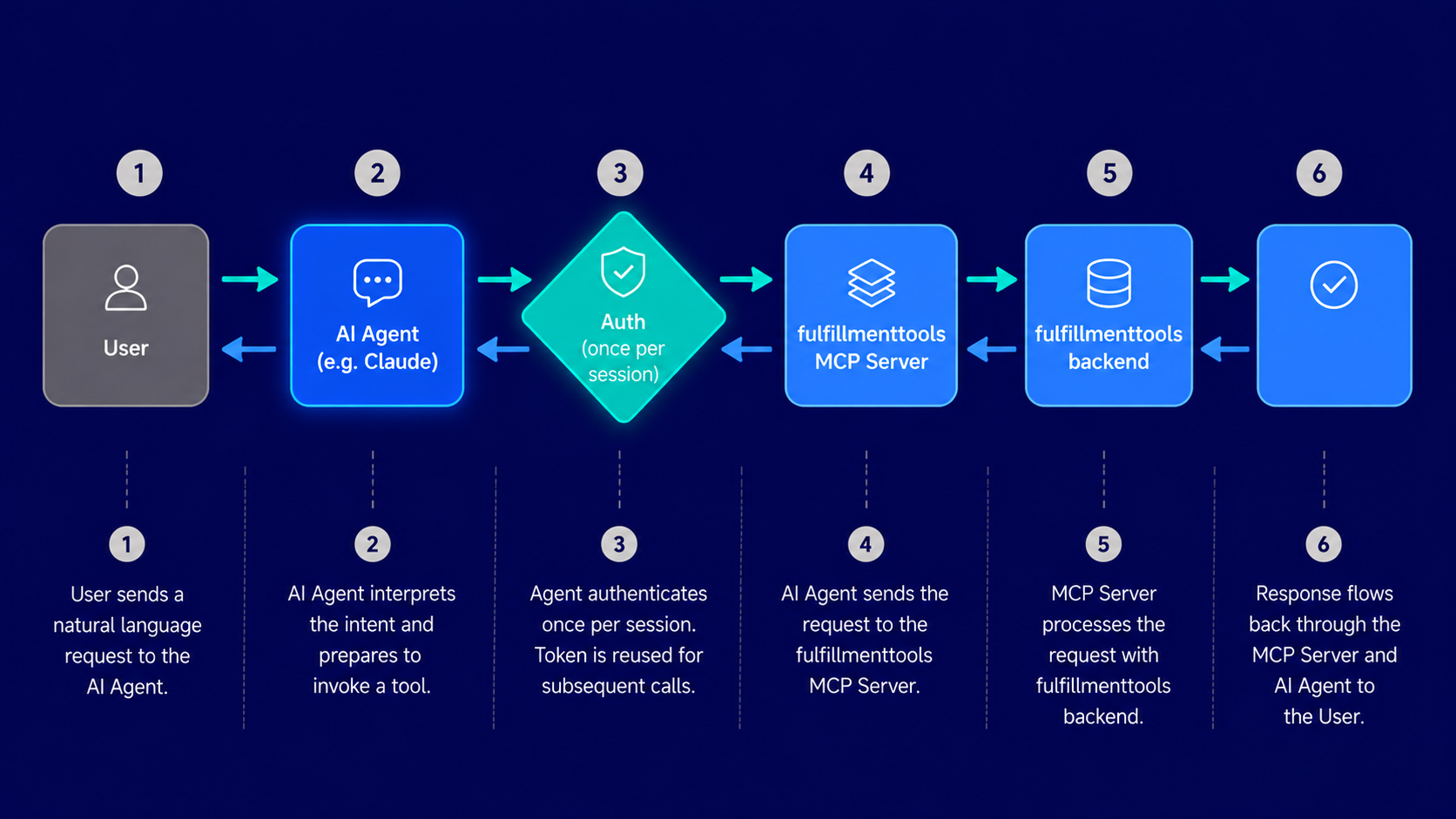
onX sits as a translation layer between agents and Order Management Systems.
An agent wants to know current inventory levels. Instead of calling a proprietary API, it makes a standardized onX request. The request follows the MCP protocol schema. The OMS receives it, validates it against the onX specification, translates it to its internal format, executes the query, and returns the result back through the same standardized interface.
From the agent's perspective, it's talking to a known standard. From the OMS perspective, it's implementing a published specification. Neither side needs to know the other's internal architecture or custom APIs.
The first version of onX focuses on read-only operations: inventory queries, product catalog access, variant lookups, order status. Write operations like order creation and fulfillment updates are planned for future releases.
All communication is authenticated. All requests follow the onX schema. All responses follow a consistent structure. The protocol provides what both agents and OMS providers have been missing: a shared contract for how they interact.
See it in action: the video below shows a Claude agent querying live fulfillmenttools inventory data via onX in real time.
What becomes possible
With onX, the operational possibilities expand significantly.
Your customer service agent can answer "When will this order arrive?" by querying live delivery promise data, not stale cached information.
Your demand forecasting agent can create fulfillment-aware predictions by checking real inventory levels across your entire network, in real time.
Your marketing platform can recommend products based not just on popularity but on actual fulfillment capacity. Launch a campaign only for products that can actually be fulfilled.
Your supply chain coordination agent can see inventory flows across stores, warehouses, and dark stores, and make intelligent routing suggestions based on live network state.
None of these requires custom integration work. All of them run on the same open protocol. All of them keep your teams in control of how agents access operational data.
[cg_inject-el="card"]
The ecosystem vision
onX enables something larger than any single integration: an ecosystem of compatible agents and systems.
Imagine a commerce stack where your Order Management System, customer service agent, demand forecasting platform, marketing automation tool, and supply chain system all speak the same language. No bespoke integrations. No locked-in relationships. Just interoperable components that work together.
That's the vision onX enables. And it's being built not by a single vendor, but by the Commerce Operations Foundation, committed to open standards.
As more OMS providers and agent developers adopt onX, retailers gain the ability to choose best-of-breed solutions without worrying about integration complexity or vendor lock-in. The market becomes more competitive. Innovation accelerates. And the benefits flow to enterprises who use these systems.
Why human oversight matters
As agents become part of operational workflows, a key principle matters: humans stay in control.
onX is designed so that agents can access data and suggest actions, but humans remain the decision-makers. An agent can flag an exception. A human approves the response. An agent can request inventory information. A human reviews the suggestion before acting on it.
This isn't a limitation of the protocol. It's a design principle. Agentic commerce works best when agents augment human decision-making, not replace it.
What comes next
The next article in this series goes deeper into the operational foundation that makes all of this possible: real-time inventory.
An agent can only make good decisions if it has access to good data. That data foundation is what we'll explore next.
This is the third article in fulfillmenttools' ongoing series on Agentic Order Management. Next: "Why real-time inventory is the foundation every AI agent depends on."
Want a deep dive into agentic commerce operations?
The future of retail is being reshaped by AI-driven, autonomous agents. Read our report to unpack how this shift is redefining the role of the Agentic Order Management System as the decisive infrastructure layer for the AI era.
FAQs
How do AI agents influence sales?
By removing friction and personalizing the buying journey, AI agents reduce abandoned carts and speed up decision-making, resulting in higher conversion rates.
What’s an Agentic Order Management System?
An Agentic OMS connects inventory, orders, and fulfillment operations across your entire network and continuously improves decision-making.
Instead of relying on static rules, it uses real-time data and adaptive logic to automatically optimize routing, availability, and order execution.
How do external AI agents connect to fulfillmenttools?
External AI agents connect via onX, the open protocol for agent-to-OMS communication, built on the Model Context Protocol (MCP) and established by the Commerce Operations Foundation, of which fulfillmenttools is a founding member. With onX, external systems gain real-time access to inventory availability, delivery promises, fulfilment options and live order data: the operational foundation on which context-aware AI decisions depend.
Written by:
Tim Dauer
VP Technology
Inspired by what you’ve read?
Talk to our team to explore how fulfillmentools can support your growth.
.png)