
From Chaos to Control: What is a Distributed Order Management System (DOMS)?

If you are a retailer with a network of different locations as well as with an online business, a Distributed Order Management (DOM) can support you to serve your customers faster and more reliably and at the same time save costs. But what is a Distributed Order Management System (DOMS) and how is it different from a traditional Order Management System (OMS)?
OMS vs. DOMS
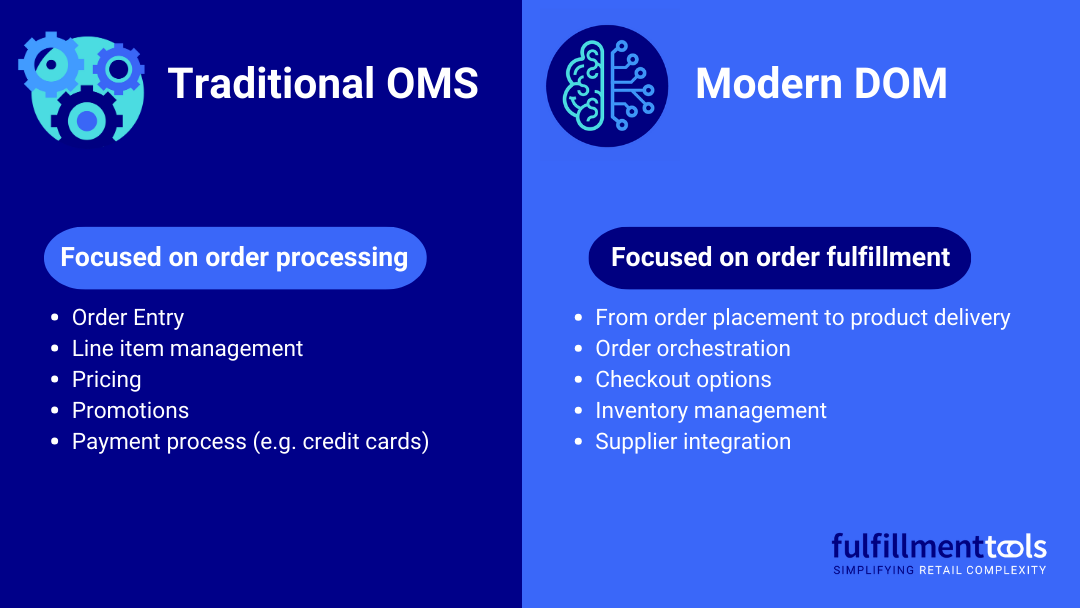
A traditional OMS is primarily focused on the whole order processing, which includes for example pricing, promotions and payment processing. It is supposed to make the internal processes efficient by automating key processes like transactions, payment and communication. In line with these tasks and in order to create smooth processes, order management is closely linked to other areas involved in getting the goods to the customers. These include, for example, warehouse management, accounting, customer service and logistics partners. However, traditional OMS were designed for a small number of sales channels with a single inventory source. They struggle with complex fulfillment networks and inventory visibility across different locations.
The DOMS is a more modern and advanced aspect of Order Management that is order-fulfillment centric. It is a software solution that coordinates the management and orchestration of the customer’s online orders, from order placement to product delivery. It can be seen as an end-to-end order lifecycle management that combines Inventory Management and Order Management. It is especially beneficial for retailers with different fulfillment locations, for example central warehouses, stores, micro hubs, drop shippers, etc, because a DOMS can connect your whole fulfillment network with your online business. In that way, retailers can create a seamless omnichannel experience for their customers and implement concepts such as Ship-from-Store or Click & Collect.
Most of what a DOMS or an OMS does is invisible to the customer but very important for both customer and retailer. Because today’s customers expect a seamless and transparent shopping experience across all channels with detailed checkout information and flexible fulfillment and return options. A DOMS enables retailers to offer their customers a seamless customer journey while they at the same time save costs and resources.
"A DOMS is especially beneficial for retailers with different fulfillment locations, for example central warehouses, stores, micro hubs, drop shippers, etc, because it can connect your whole fulfillment network with your online business."
What are the Key Features of a DOMS?
1. Fulfillment Options
While a customer places their order in an online shop, they want transparent information about service options. This primarily includes checkout information about product availability in each store and in the online shop, delivery times, delivery services, pick-up options, etc. With the help of a DOMS that offers inventory visibility across all storage locations and is connected to all shipping providers, retailers can provide their customers with this information.
2. Routing of Customer Orders
After the customer places their order, the DOMS routes the order to the best fulfillment location, which can for example be a store or a warehouse. This process is completely invisible to the customer. Intelligent algorithms choose the most appropriate way to fulfill the order based on the retailer’s individual criteria, for example a cost-optimized delivery, and the customer’s wishes, for example a fast delivery. The DOMS provides the best possible customer experience while at the same time being as efficient and cost-saving as possible for the retailer. These two aspects sometimes contradict each other, but the DOM finds a good balance between them due to the possibility to set criteria and rules. A modern DOMS provides many different configuration options.
3. Inventory Visibility
To have a basis for the order handling, retailers need visibility into inventory across their fulfillment network, so they know exactly how much stock they have at which location and which is the best fulfillment location for each order. In that way, Inventory visibility helps to find the perfect balance between on- and offline demand and steers the demand accordingly. Therefore, the DOMS ensures that goods aren’t sold out too quickly or remain in the stores as shelf warmers.
4. Integrating the Last Mile
After the order is routed to a fulfillment location, it needs to be shipped to the customer. A fast and flexible delivery is important for the customer journey and loyalty. A DOMS has a connection to as well as all relevant information about the carriers and can consider them during the routing process.
5. Managing Returns
The DOMS also simplifies return processes. It is beneficial for retailers to integrate stores into the returns process as receiving points for returns of online orders as this can keep retailer’s transport and logistics costs low, increase the relevance of stores and enhance customer satisfaction.
What are the Benefits of a DOMS?
An intelligent DOM simplifies the retailer’s fulfillment process by consolidating all order and inventory data and smartly matching customer preferences with the complete distribution network. There are many benefits that come along with this.
Decentralized warehousing: The decentralization of warehousing brings many benefits, such as enablement of instant and same day delivery, Click & Collect and In-Store-Returns everywhere.
Reduced out of stock: By connecting online and offline, the entire inventory is accessible and thus available in the network. This reduces the risk of articles being out of stock when demand arises.
Reduced costs: By intelligent order routing and inventory visibility, a DOMS can help you sell off stocks, reduce overselling and underselling, delivery, storage and administration costs as well as increase efficiency and automate processes.
Utilized workforce and resources: Staff in stores in particular are not constantly busy. By dovetailing online and offline, retailers can use this capacity for fulfillment and increase store profitability at the same time and meanwhile not overburden the employees.
Improved customer satisfaction: A DOMS enables retailers to offer customers a good shopping experience on all channels with a broad service portfolio ranging from availability displays in the online shop to fast fulfillment and various delivery options such as Quick Commerce, Same and Next Day Delivery, Click & Collect or Click & Reserve and simple returns processes.