
How DOMS Order Routing Navigates Retailers Through Fulfillment Diversity

Today‘s consumers buy their desired products and services via various channels – stores, online shops, marketplaces and social media. At the same time, their expectations are shaped by major players such as Amazon – customers want a seamless, personalized and „in-time“ shopping and fulfillment experience across all channels, which can be realized through intelligent order routing. Retailers can achieve this with implementing a Distributed Order Management System (DOMS). In this second part of our blog series about DOMS, I will go into detail about the extent of orders that retailers have to deal with and how DOMS helps in handling these.
Read the first part of our blog series about the difference between traditional OMS, Next Gen OMS and DOMS here!
The use of different sales channels, both online and offline, provides customers with various options to order and purchase goods and services. This significantly improves the customer experience and makes time and space restrictions less relevant. Retailers, in turn, can offer their stock on multiple channels, potentially thereby attracting more customers and increasing sales. Overall, there are several options for both sides to do business: Omnichannel is a win-win situation.
However, with more options come challenges for retailers. If there are many options for the delivery route, for example how the bought products get to the customer, it is important to determine the best option. This is because a delivery can take more or less time, differ in costs, may need to be split up or must meet special requirements such as hazardous goods criteria. Once an order is placed, all these factors must be evaluated within milliseconds. Retailers need to balance enhancing the customer experience—such as offering fast and affordable delivery—while optimizing costs on their end.
Omnichannel is a win-win situation.
The magnitude of fulfillment options for order routing: A sample calculation
A closer look at the magnitude of the task reveals the technical challenges involved.
The simple case: Let‘s assume a customer orders four products. In this case, there are ten possible fulfillment locations (stores, department stores, warehouses) for each product in their shopping cart. An order split (splitting the order between different locations) is not desired, so the order routing assigns the entire order to a single location. There are therefore ten options for fulfilling the order. However, the risk here is that no location may have all items in stock. Without splitting the order, the customer may not receive their complete order or any part of it at all.We go one step further: For the customer journey, it is advantageous to offer more than one shipping service provider. Suppose the retailer offers the customer a choice of two shipping service providers and has not ten but 100 locations available for fulfillment. In this more complex scenario, the customer orders four products and order splits are possible. This results in (100*2)4 = 1,600,000,000 options for processing the order.
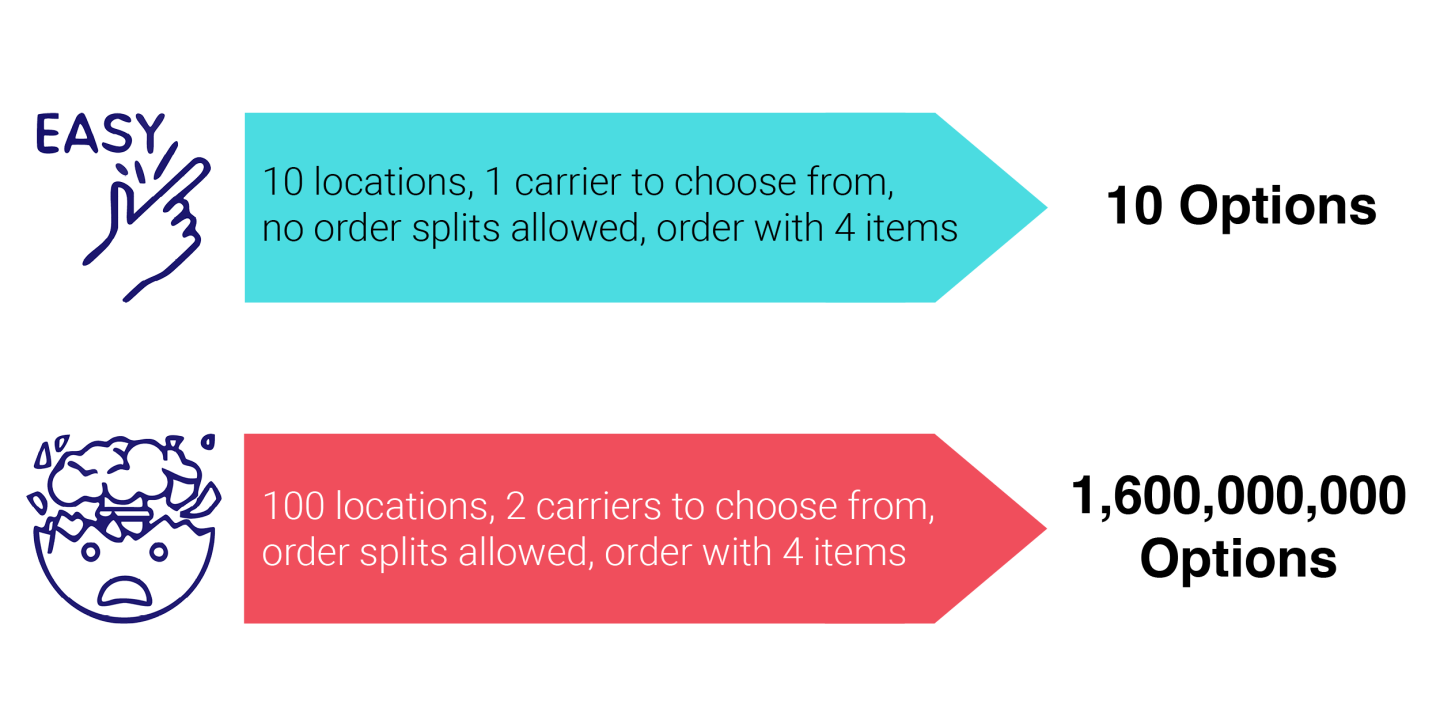
In addition to the sheer number of options, various factors add to the complexity of the fulfillment process. These factors include a globally distributed network, industry-specific requirements, for example regarding margins or hazardous goods criteria, or special customer service requirements. This challenge is far from trivial, even for a modern computer, because calculating all the options can take several minutes. However, in addition to the complexity, the process needs to be extremely fast, especially during the checkout phase. When a customer is making their decision and wants to be informed about the delivery options, this information must be provided quickly and reliably, as it often influences the purchase decision. Customers typically choose the cheapest, fastest, or most predictable delivery. Therefore, this crucial information must be available and evaluated by the Order Routing within milliseconds.
Navigating fulfillment options with Order Routing aided by AI
DOMS Order Routing addresses these challenges by enabling the intelligent and optimal distribution of customer orders across the retailer’s fulfillment network. This simplifies processes and enhances resource utilization, including inventory and personnel. As a result, costs are reduced, and profitability is increased. With a DOMS, retailers lay the foundation for linking digital touchpoints with all available inventory sources, standardizing information related to availability, delivery, and service across all channels. Retailers can offer their customers a perfect shopping experience by, for example, shortening delivery and collection times, providing comprehensive information, or offering flexible services. This fosters customer satisfaction and loyalty, ultimately boosting sales. In this way, retailers can impress with their omnichannel experience and distinguish themselves from the competition over the long term. DOMS optimizes various aspects of a retailer’s order processing. This allows retailers to save costs at various points and generate more revenue.
Many order routing systems operate with a sequential set of rules, akin to a decision tree. This method attempts to find one or more sources of supply to fulfill the order based on exclusion criteria. If an option is found, the problem is considered solved. However, it does not ensure that the first solution is the best one. Often, crucial factors such as delivery costs and delivery times, which significantly impact both the retailer‘s margin and the customer experience, are not included in the decision-making process. The sequential arrangement of rules is limited in its ability to weigh up individual options against each other.
It is impossible for a normal, modern processor to calculate all delivery options within one second. It would take several minutes. Therefore, an optimization process must be used to find the best possible result within just a few milliseconds using intelligent procedures. This is what our DOMS Order Routing was developed to achieve. The aim of DOMS is not merely to calculate any solution for sourcing, but to determine the best possible solution within milliseconds. This involves considering and balancing all criteria crucial to the retailer through an optimization process aided by AI.
The aim of DOMS is to determine the best possible solution within milliseconds. This involves considering and balancing all criteria crucial to the retailer through an optimization process aided by AI.