
AI in Retail Part 2: How Artificial Intelligence Powers Order Routing

Introduction
Artificial Intelligence (AI) is here to stay and can have a huge impact on businesses – if used correctly and thoughtfully. In this blog series, we want to give an overview of the AI use cases for Order Management Systems (OMS). In the first article, we have discovered Machine Learning use cases for Order Management. In this post we want to dive into one of these use cases where AI might be most beneficial: Order Routing.
Artificial Intelligence in Order Routing
Retailers who have numerous sales channels and ship from multiple locations face complexity in fulfilling customer orders efficiently. A routing engine that is powered by AI will help retailers shorten delivery times, lower costs, gain inventory control, and increase conversions and sales.
Let us assume you
- have 24 inventory locations, consisting of warehouses, stores, dropshippers, etc.,
- have an average basket size of 4 items,
- offer the choice of 2 different shipping providers
- allow split orders
In this case, the number of possible routing options for an order is 5.308.416.
Alongside the vast array of options, various factors contribute to the complexity of the fulfillment process. These include:
- globally distributed networks
- industry-specific requirements
- unique customer service demands.
Every company is different and therefore will have a different goal around their routing decisions.
In order to fulfill the order successfully, to meet customer demands and to save costs, it is crucial to not just find any option for fulfilling the order but the best option out of a lot of possibilities.
This challenge is far from trivial, as calculating all possibilities can take several minutes. However, the process must not only manage complexity but also be exceptionally swift, particularly during the checkout phase. Consequently, this critical data needs to be available and assessed within milliseconds.
If you want to calculate your own routing options for yourself, you can do that with our Order Routing Calculator.
Solve routing complexity with AI algorithms
It is impossible for a modern processor to calculate all delivery options within one second. Therefore, retailers need a powerful Order Routing engine that uses an optimization process to find the best possible result within just a few milliseconds. The aim of the Order Routing engine is not merely to calculate any solution for sourcing, but to determine the best possible solution within milliseconds. This involves considering and balancing all criteria crucial to the retailer during an AI-powered search process that combines machine learning and combinatorial optimization algorithms.
Those AI algorithms analyze different factors to determine the most efficient fulfillment center for each order, such as:
- inventory levels
- demand forecasts
- supplier reliability
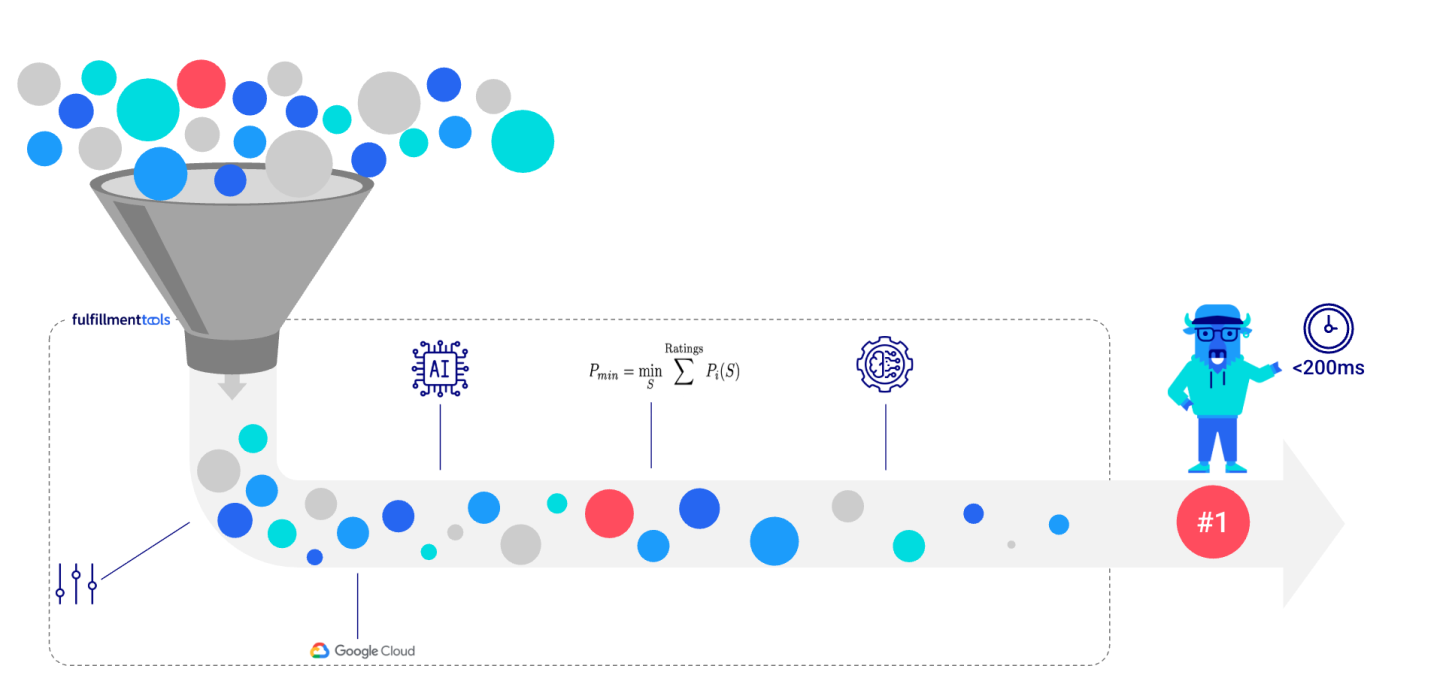
A routing engine selects the best fulfillment option for an order from many different options in the shortest possible time.
To identify the optimal routing option swiftly, the routing engine employs an optimization method that groups alternatives and uses probabilistic combinations to determine the best solution available within the limited timeframe.
However, there may be even more optimal solutions that the algorithm overlooks and thus excludes from consideration. After the routing decision is made, AI continues to review other possibilities in the background to evaluate whether a better solution could have existed. The system applies the new knowledge during the next calculation process and thus, the algorithm starts optimizing with a different approach. This continuous learning process ensures improving results over time, making the system increasingly efficient with each iteration.
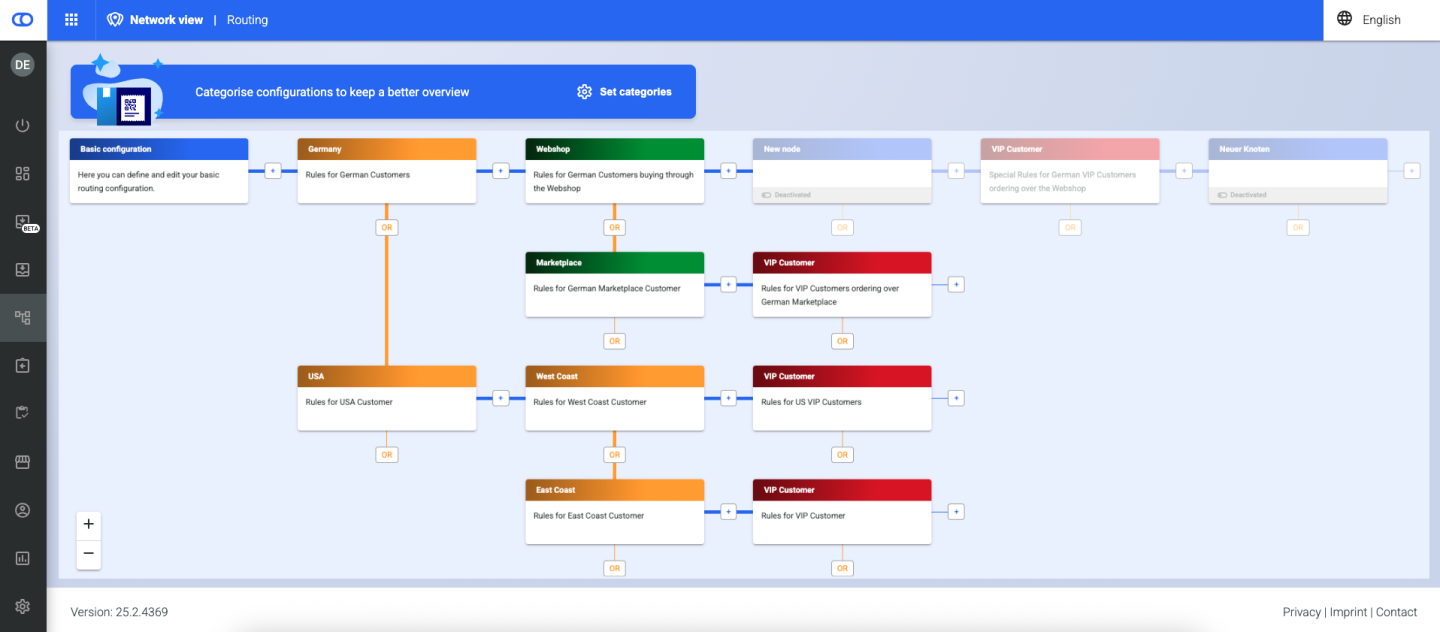
Example of a routing strategy based on individual retailer criteria
Benefits of a Artificial Intelligence powered Routing Engine
An AI powered Order Routing engine brings several benefits:
- It enables the intelligent and optimal distribution of customer orders across the retailer’s fulfillment network.
- It simplifies processes.
- It enhances resource utilization, including inventory and personnel.
- As a result, costs are reduced, and profitability is increased.
With a Distributed Order Management System (DOMS), retailers lay the foundation for linking digital touchpoints with all available inventory sources, standardizing information related to availability, delivery, and service across all channels. Retailers can offer their customers a perfect shopping experience by:
- shortening delivery and collection times,
- providing comprehensive information about shipping and availability,
- offering flexible services.
This fosters customer satisfaction and loyalty, ultimately boosting sales. In this way, retailers can impress with their omnichannel experience and distinguish themselves from the competition over the long term.
Conclusion: Artificial intelligence in Order Routing
Leveraging Artificial Intelligence within Advanced Order Routing offers many advantages for retailers navigating the complexities of a diverse fulfillment network. The use of AI enables swift and accurate decision-making by evaluating numerous factors to deliver optimal routing solutions in milliseconds.
Even though not all potential options might be considered initially, the continuous learning capability of these systems ensures constant improvement, making each iteration more efficient than the last. By effortlessly optimizing order distribution across fulfillment networks, retailers can:
- reduce costs
- boost profitability
- enhance customer satisfaction through faster delivery, better information, and flexible service offerings
Embracing this technology allows retailers not only to meet the high expectations of their customers but also to stand out in the competitive market by providing an exceptional omnichannel shopping experience.